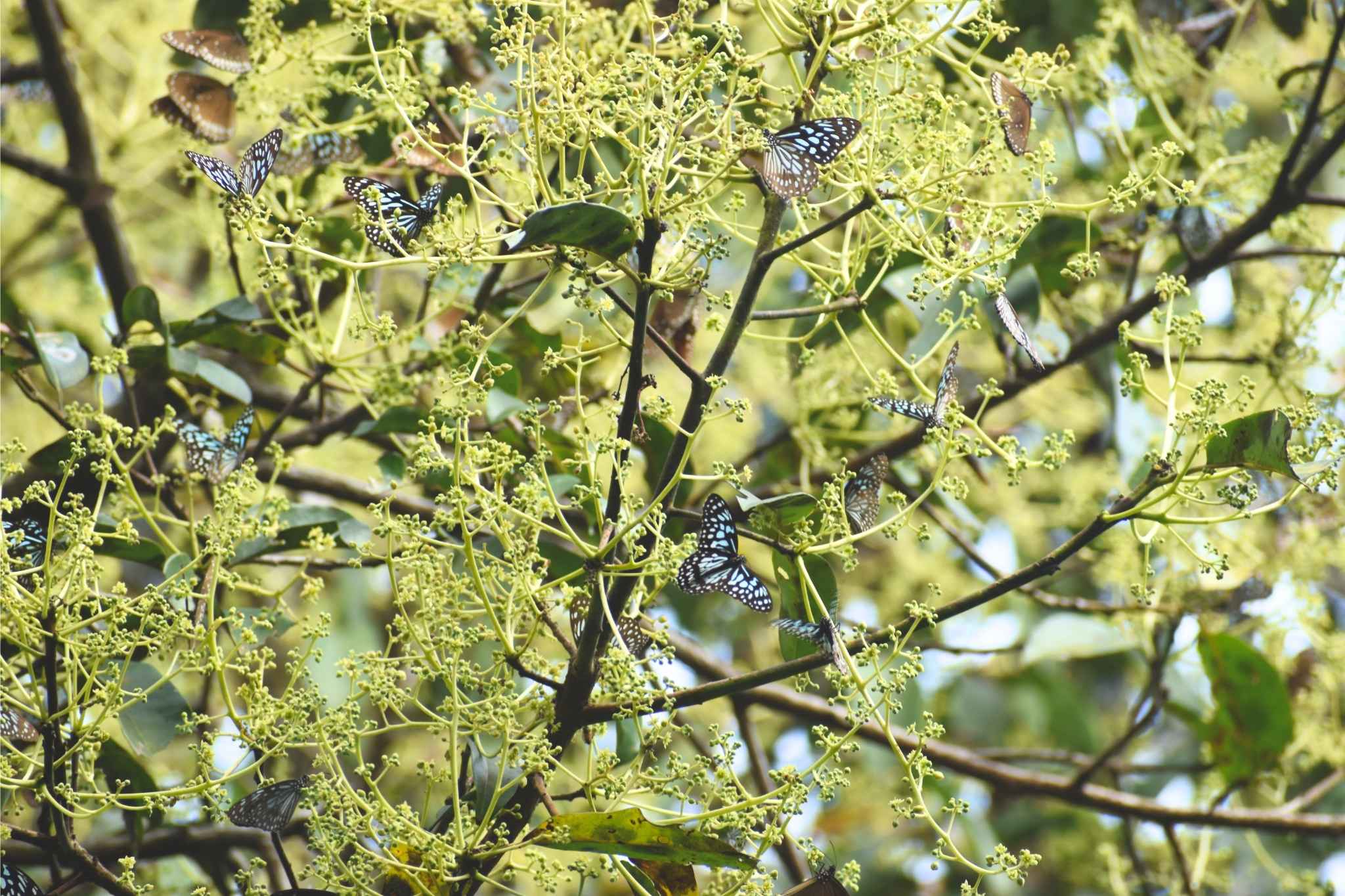
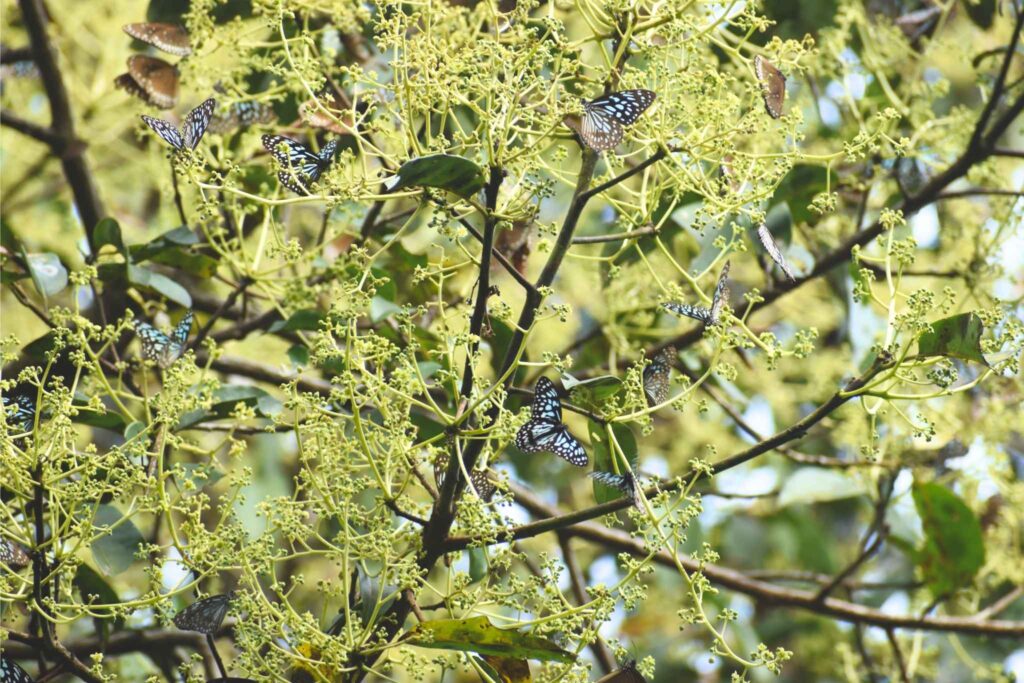
Butterflies, including the Dark Blue Tiger, on the branches of a Large-Flowered Bay Tree, Persea macrantha.
I grew up in Wayanad, part of the Western Ghats—a living landscape where forests and people have shaped one another for centuries. Here, forests have never been a distant backdrop. They have quietly guided daily life, offering food, shelter, livelihoods, and meaning. So when Wayanad recently declared the Dark Blue Tiger, a migratory butterfly, as its district butterfly, it felt more than symbolic to me; it felt deeply appropriate.
Wayanad is a land shaped by movement. People have lived here for thousands of years, always in close conversation with forests. Over time, individuals and communities from many different landscapes have arrived—some to settle, others to work, many only to pass through. Growing up in this landscape, I learned early that life here has always flowed—arriving, staying, moving on, and sometimes returning. In that sense, a migratory butterfly reflects Wayanad itself.
There is something quietly profound about these butterflies. Each year, they arrive from the eastern plains in vast numbers, moving across peninsular India without recognising the boundaries we draw—of districts, states, languages, or cultures. Watching them move through forests and fields, carrying pollen from one place to another, I am often reminded that life is far more connected than we usually allow ourselves to see.
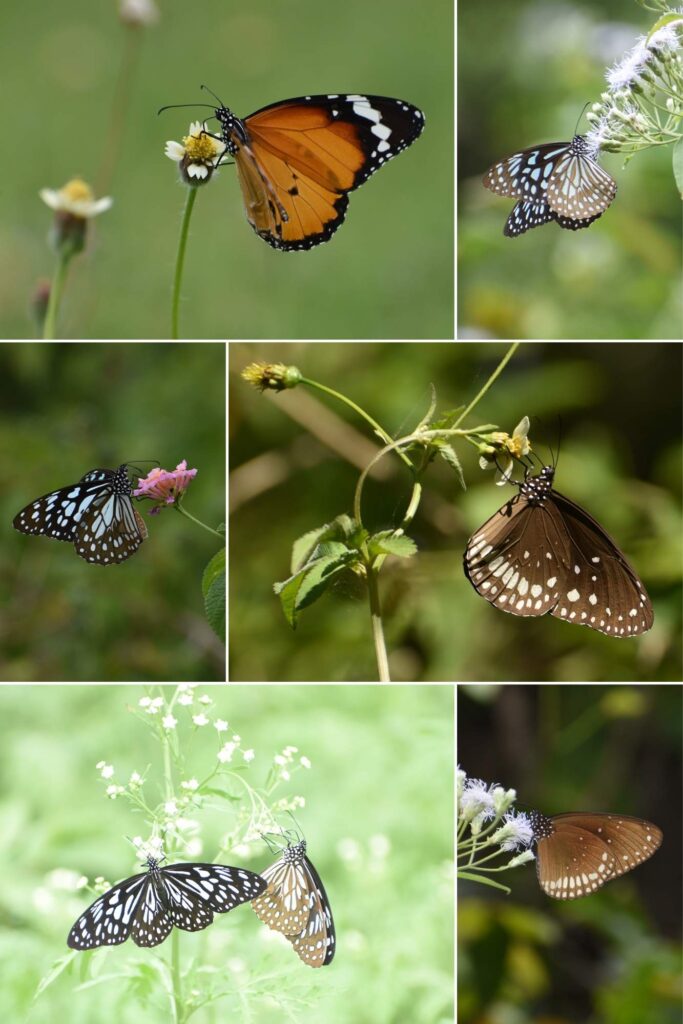
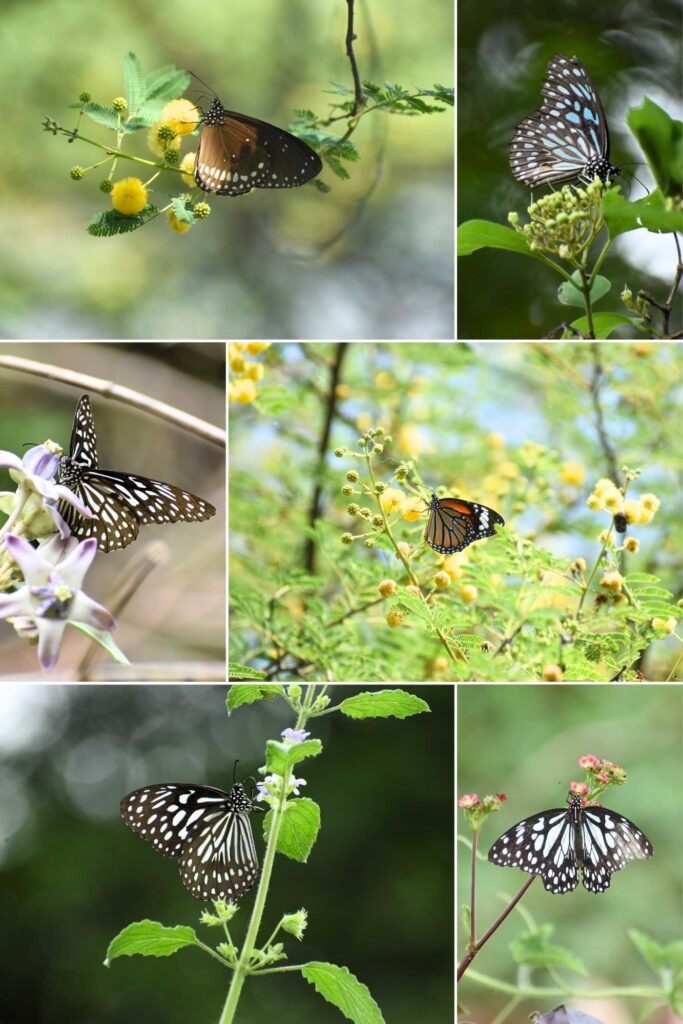
Butterflies on some of the invasive plants of peninsular India. In order of appearance (Left to Right): Plain Tiger, Dark Blue Tiger x2, Common Crow, Dark Blue Tiger, and Common Crow.
For a long time, “flowers and butterflies” were just a familiar metaphor for beauty to me. But that changed when curiosity led me to begin following migratory butterflies, simply to understand where they were going. I did not realise then that the journey would teach me far more than their destinations.
For the past eight years, butterflies have shaped my travels. In a time when studying a species that is neither rare nor officially threatened attracts little attention or funding—especially in India—my work on butterfly migration survived largely on friendships. With that fragile yet powerful support, I began to follow these insects across large parts of peninsular India.
At first, my questions were simple: Where do migratory butterflies come from? Where do they go? As the journeys grew longer, so did the questions. Clear answers remained elusive, but one insight slowly emerged. The butterflies that arrive in the Western Ghats from the eastern plains do not return after producing a new generation here. The very same butterflies that arrive are the ones that eventually depart.
The annual migration of milkweed butterflies to the Western Ghats is a fascinating phenomenon. Millions of butterflies fly from the eastern parts of peninsular India toward the Western Ghats each year. Most people notice migratory butterflies only when their numbers become impossible to ignore. Species belonging to the milkweed butterflies—such as Blue Tigers and Crows—can gather in astonishing numbers in the forests of the Western Ghats. In some years, I have watched forest patches fill with more than two lakh butterflies, the air itself seeming to move.
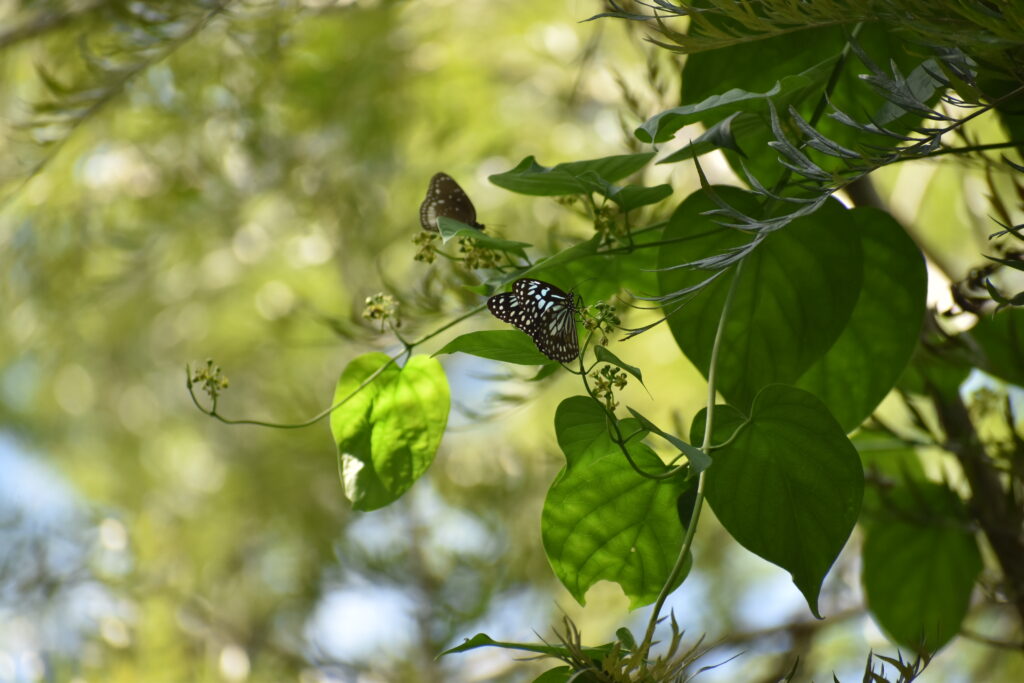
The Green Milkweed, Cosmostigma cordatum, serves as the larval host of the Dark Blue Tiger and is also a general nectar source for Milkweed butterflies.
Unlike many butterflies that visit flowers briefly and alone, migratory milkweed butterflies spend much of their adult lives in large groups. I have often seen thousands feeding together on a single flowering tree—moving, resting, and feeding in synchrony. These gatherings are never random; they closely follow the seasonal rhythms of the Western Ghats.
Arriving in such vast numbers, these butterflies collectively visit billions of flowers across many plant species. In doing so, they play a significant role in pollination and seed formation, which in turn supports fruit production and food availability for birds and other fruit-eating animals. Through this quiet yet immense contribution, migratory butterflies help sustain forest regeneration and the continued existence of plant communities across the landscape.
The butterflies begin arriving in the Western Ghats just as the southwest monsoon loosens its grip on the mountain slopes. Almost immediately, forest trees start flowering, one after another. Only the earliest arrivals are able to feed on the Indian Kino Tree (Pterocarpus marsupium). By the time Ceylon Olive (Elaeocarpus serratus) comes into bloom, butterfly numbers swell dramatically, and thousands can be seen feeding on individual trees. As the Ceylon Olives finish flowering, Soap Nut (Sapindus spp.) trees take over, and the forests seem to erupt in colour once again.
As summer deepens, I have watched Indian Persea (Persea macrantha) trees shed their leaves and stand covered in white blossoms. Then come the Malabar Cinnamon (Cinnamomum malabatrum) trees, followed by several species of Litsea. During the hottest months, when only a few trees flower at a time, butterflies gather in specific forest pockets, as though certain trees bloom especially for them—offering nectar like a private feast.
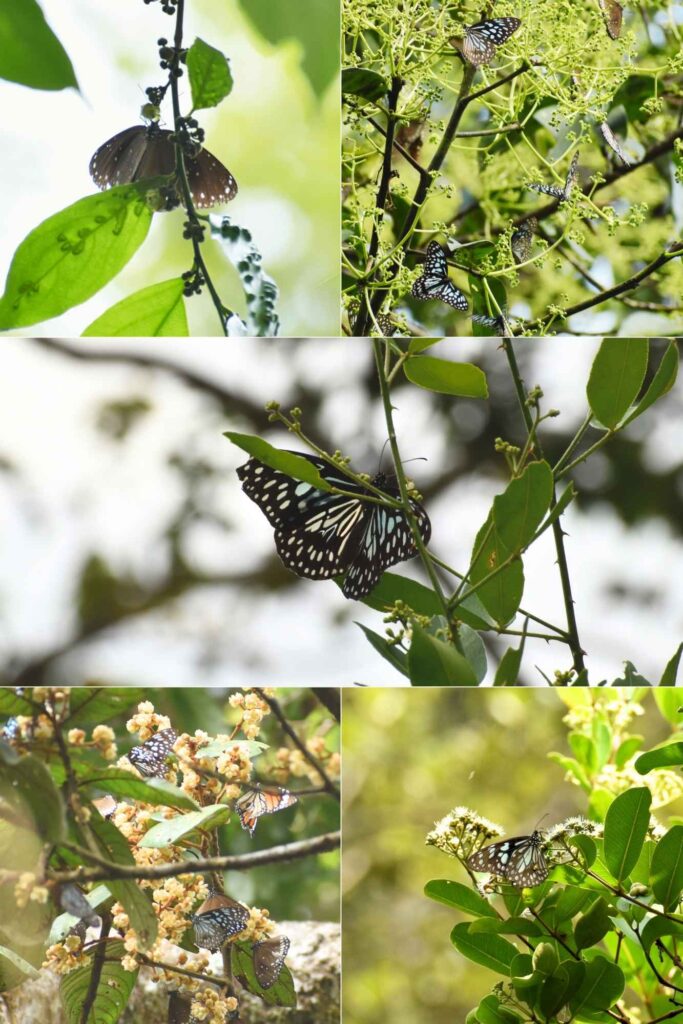
Dark Blue Tiger and other butterflies on some of the native plants of the Western Ghats.
What fascinated me most was not just where butterflies fed, but where they did not. Even when some trees stood in full bloom, they were completely ignored. This selectivity suggested that butterflies respond not to abundance alone, but to specific cues such as nectar quality and accessibility. Over time, it became clear that this was part of a finely tuned forest mechanism supporting diverse life.
Just before the pre-monsoon rains, I would notice Jamun trees (Syzygium spp.) beginning to flower. By then, migratory honeybees would also be arriving in the forests. Butterflies and bees shared the nectar, and soon the first summer showers followed. By April and May, most forest trees were in bloom. And yet, before the buzzing of bees filled the canopy, the butterflies would depart—almost as if they were deliberately avoiding competition.
“They are living corridors—quietly maintaining genetic diversity, reconnecting broken landscapes, and sustaining ecological continuity in a changing world.”
As they moved on, flying eastward from the Western Ghats before the monsoon, these butterflies likely carried pollen from trees such as Jamun back toward the plains. This movement turns them into agents of gene flow, transferring pollen between plant populations separated by geography, rainfall, and increasingly, by habitat fragmentation.
Some of the plants from the Eastern Plains. In order of appearance (Left to Right): Double Banded Crow, Dark Blue Tiger x2, Common Tiger or Striped Tiger, Dark Blue Tiger, and Blue Tiger.
During their long migrations from the Eastern Ghats and adjoining plains, I realised they feed on the trees like Indian Kino trees in hot, low-rainfall regions and later on the same species in the rain-rich forests of the Western Ghats. In doing so, they unknowingly transport pollen across contrasting climates. Through this exchange, butterflies may help introduce traits that improve tolerance to heat and water stress. In an era of growing climatic uncertainty, such movements can strengthen the climate resilience of forests.
As they complete their back-and-forth journeys across peninsular India, these butterflies pollinate a remarkable diversity of plant species across multiple bioclimatic regions. In this sense, migratory milkweed butterflies may well be among the most important butterfly pollinators in India.
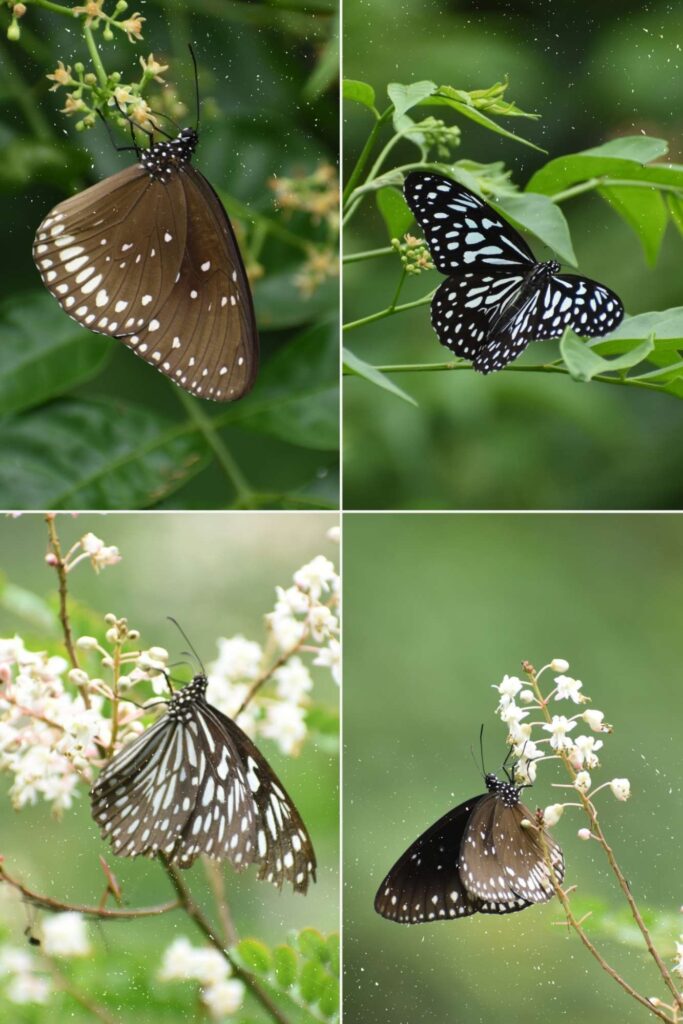
Plants from the Eastern Ghats.
Over the years, I have come to see migratory butterflies as far more than seasonal visitors. They are living corridors—quietly maintaining genetic diversity, reconnecting broken landscapes, and sustaining ecological continuity in a changing world. In their effortless movement across borders we fiercely defend, they remind us, again and again, how fragile—and often meaningless—those boundaries truly are. And in their silent journeys across seasons and landscapes, they show us that life remains connected long after our borders fade.
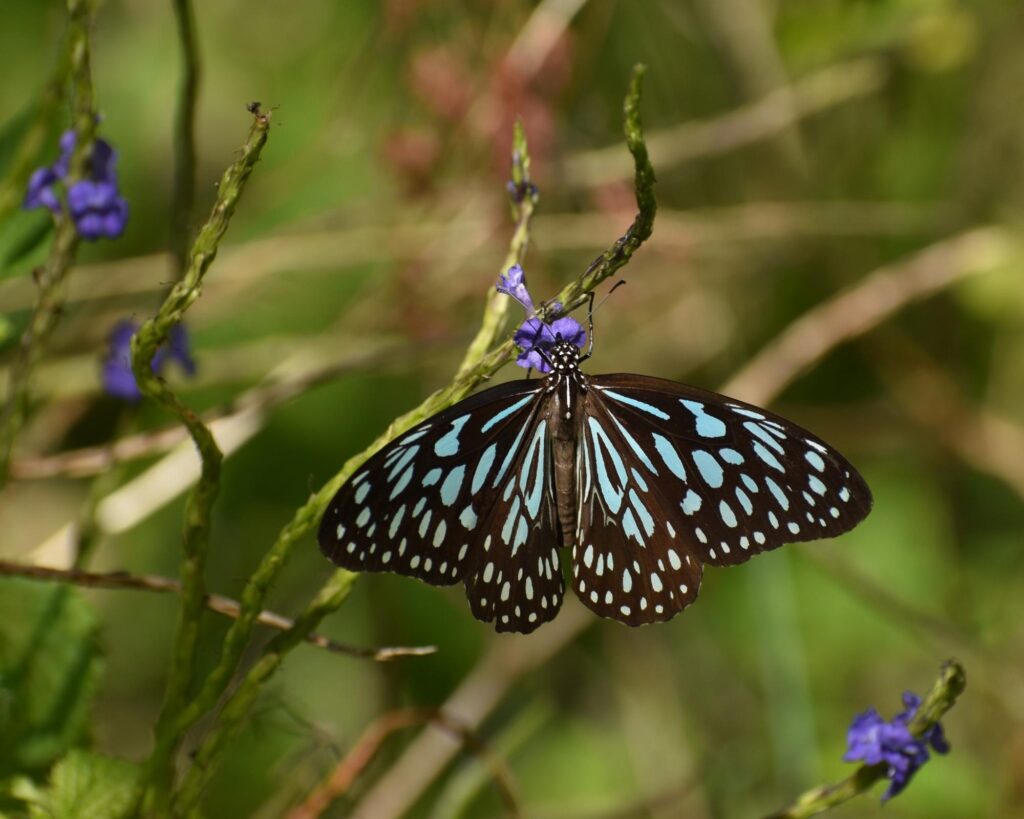
A Dark Blue Tiger on an exotic herbaceous plant called the Blue porter weed, or the Stachytarpheta jamaicensis
This blog and all the photographs are by Vinayan P.A. Vinayan is a conservation biologist with over 20 years of experience in ecological research and conservation in the Western Ghats of southern India. His work focuses on plant–animal interactions, ecological restoration, and invasive species management. He serves as Secretary of FERNS, a conservation society based in Wayanad, and works as a consultant with the Keystone Foundation. His recent research explores the migration ecology of milkweed butterflies in peninsular India.