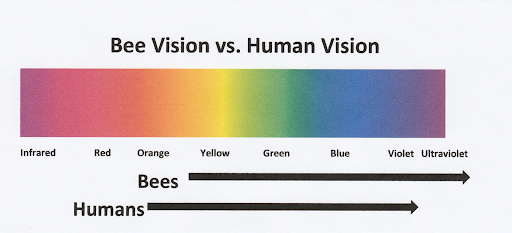

Karl von Frisch, a Nobel Prize-winning scientist, proved that bees can see colour. Humans are able to see so many colours due to something called trichromatic vision. This means that we can see several combinations of red, blue and green. Bees have trichromatic vision as well, only, they can see combinations of green, blue and ultraviolet. This means that bees have a much broader range of colour vision. Being able to see ultraviolet light means they have an advantage when seeking nectar. There are patterns on flowers that can only be seen by organisms that can perceive ultraviolet light. These nectar guides that bees are able to see make it much easier for them to find nectar. Some flowers even have nectar guides that can only be seen in ultraviolet light. Another interesting fact is that bees are able to see colour much faster than humans. Along with ultraviolet light, bees can also see depth and have three dimensional vision. They also have the ability to judge distance well.

Bees have two types of eyes, each for a different purpose. The three smaller eyes in the center-top of a bee’s head are called ocelli. Ocelli comes from the Latin word “ocellus” which means little eye. These little eyes have single lenses which help with navigation. They also help with stability, as it enables them to judge light intensity and stay oriented. The larger compound eyes are made of thousands of individual hexagonal units called Ommatidia. Each Ommatidium contains a single lens with a cone of photo-receptor and pigment cells. Honey bees are actually quite near sighted. They are able to compensate for this, though, by having the extraordinary ability to see things while in motion. Bees can see and process colours five times faster than humans can. Another advantage bees have is a much wider field of vision. While humans can only see 180 degrees, bees have the ability to see 280 degrees.

With this “bee vision”, bees are able to pollinate flowers with very high accuracy. Their ability to see in a way that we can’t is what makes them such important pollinators.
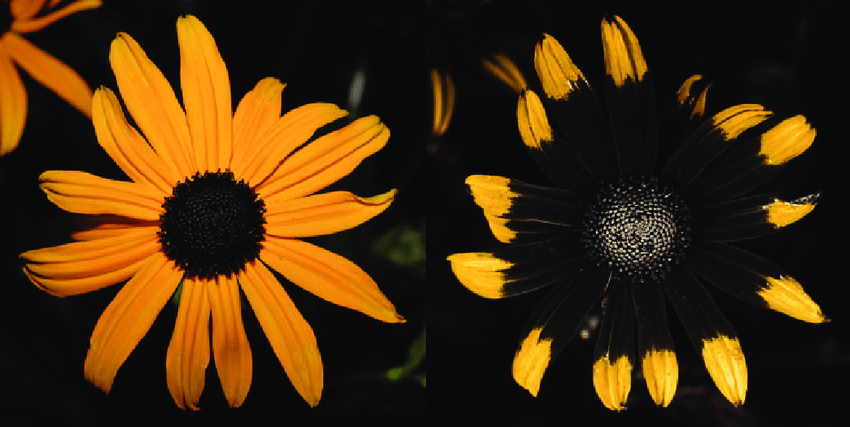
Pictured above: A UV-visible nectar guide. Photography of Rudbeckia hirta in either visible (left) or false-coloured reflected UV light (right) reveals the nectar guide visible to insects but not the human eye.
Nectar guides are visual cues that bees use to locate nectar. These guides can only be seen on the ultraviolet wavelength. These markings help guide bees to the center of the flower where the pollen is located, almost like a ‘bulls-eye’.
https://marisamorby.com/bee-vision
Blog by: Ammer Pannu, Intern at Keystone Foundation, July 2025